
IRD59-2
ACTIVE INFRARED (IR)
TRIP-BEAM DETECTOR
IRD59-2
ACTIVE INFRARED (IR)
TRIP-BEAM DETECTOR
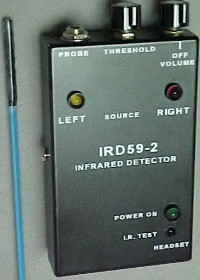 The IRD59-2 detects the presence of an infrared (IR) trip-beam being used either for alarm purposes or triggering of an improvised explosive device. The system consists of the detector assembly, IR probe with detectors on two sides that are covered with an Wratten IR filter, probe extension cable and high impedance headset. The detector contains an integral I.R. TEST led that transmits a 1,000 hertz tone for testing the system. One 9 volt and one 1½ volt "AA" alkaline battery power the unit. The unit detects the following types of IR beams and reacts as described. 1. Continuous (DC) light beams. As the probe is passed through the IR beam either the yellow LEFT light emitting diode (LED) or the red RIGHT LED will light. When the IR source is to the left of the unit, the LEFT LED flashes and an internal vibrator pulses on and off. When the IR source is to the right of the unit, the RIGHT led remains lit and the vibrator runs continuously. NO tone is heard through the headset. 2. IR beams that are modulated with the power line frequency (60Hz) or harmonics thereof. The intensity of the IR beam determines whether the RIGHT and LEFT led's will light but a strong 60Hz, 120Hz, 180Hz, 240Hz, etc. tone are heard through the headset. 3. IR beams modulated with fixed or warbling tones in the audible range are heard though the headset. 4. IR beams modulated with tones that vary in pitch and depend on the distance to the reflector. They are usually above the normal hearing range but are converted down to the audible frequency range by the IRD59-2 and heard through the headset. Inaudible tones up to 100,000Hz are converted to audible tones. Regardless of the detection mode, the THRESHOLD control must be set to compensate for ambient light conditions. Normally it is set so that both the LEFT and RIGHT led's are barely extinguished. The VOLUME control adjusts the audio output level and turns the unit OFF. Make sure the unit is operating properly by occasionally passing the probe over the I.R. TEST led. |
|
|
1/16