
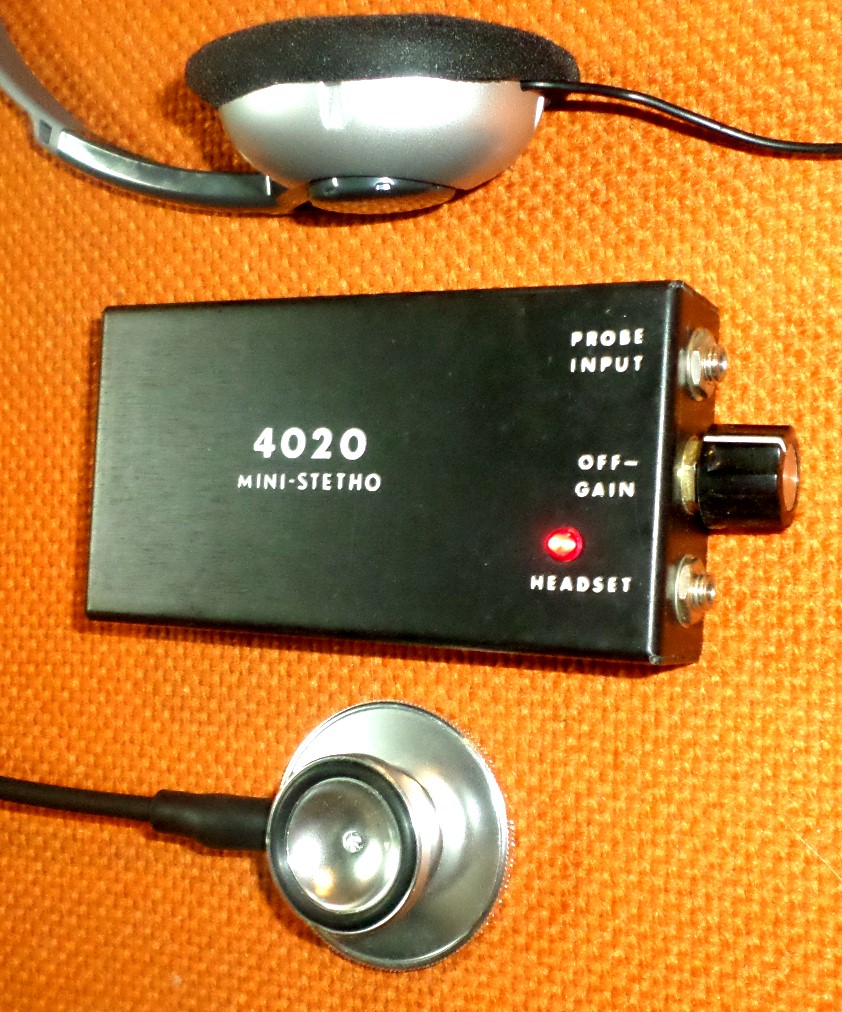
The 4020 detects conducted sound from clocks or mechanical triggering devices. The unit is supplied with amplifier assembly, contact microphone and headset. It is shipped configured for use with the contact microphone supplied although it can also be used as a general purpose amplifier by making a few internal changes. To use as an amplifier, remove the cover, plug the zero ohm resistor (single black stripe) into the small jack next to the integrated circuit. Move the resistor connected to the input jack to the small jack nearest the volume control. TO OPERATE: Insert the plug from the contact microphone into the PROBE INPUT jack. Insert the headset plug into the HEADSET jack. BE CAREFUL! Don't get the right plug into the wrong jack. Hold the transducer firmly on the surface being tested and adjust the GAIN as desired. A single 9 volt battery (Alkaline preferred) powers the 4020. Normal battery life is approximately 100 hours of ON time. As with any battery operated equipment, remove the battery during periods of prolonged storage. Treat this piece of equipment as you would any other sophisticated electronic equipment. Do not expose to water or temperatures in excess of 120 degrees F. Remember, the glove compartment or trunk of a car can easily exceed this limit on a bright sunlit day. Use common sense. To replace the battery, loosen the two cover screws one or two turns counterclockwise and, with the lettered side down, carefully remove the back cover. Remove the old battery and replace with a fresh one (Alkaline always preferred). Replace the cover being careful not to pinch the battery leads and tighten the screws (do not over-tighten). Although designed primarily for bomb detection, the 4020 has many, many applications. Some applications, however, may be controlled by 18USC2512 or other federal, state or local laws. It is the owner's responsibility to check for lawful use.
5/17 |